You have been working for several years at the Federal Ministry for Economic Affairs and Energy, what is your main responsibility?
I am part of a small team of lawyers specialising in EU law who represent Germany before the European Court of Justice, the General Court and the EFTA Court. The team represents the German position in so-called direct actions (e.g. infringement proceedings or actions for annulment) and in preliminary ruling proceedings, both in the written and oral phases of the proceedings. The cases cover all aspects of EU law.
Which current topics are you working on?
I work on cases concerning EU values such as non-discrimination and the protection of fundamental rights (Art. 2 TEU), the free movement of Union citizens, fundamental freedoms, and cases concerning the Common European Asylum System (CEAS).
How did you come to teach in CIFE’s Executive Master in EU Studies?
I have been teaching in CIFE's Executive Master in EU Studies since 2013. At that time, Prof. Ingolf Pernice, whom I know from my time at Humboldt University in Berlin, asked me to join CIFE, and I gladly accepted the offer. The Executive Master offers an ideal mix of theory and practice; it is interdisciplinary and international. The face-to-face workshops stretching over two years are a unique opportunity to grow together as a group. We now meet alumni in many of the cities where the workshops take place. The fact that they keep in touch with each other and with CIFE is proof to me that two years of learning together can forge bonds that last a lifetime.
What inspires you most about teaching in higher education?
I enjoy challenging students – and being challenged by them. And I hope that I can convey to students the importance of EU law in everyday life.
What are the key lessons that you want to convey to the students? Which skills should they acquire?
My area of expertise is law, in particular EU law. In the second year of the Executive Master programme, we focus on legal methodology, i.e. students acquire or improve their skills in analysing and drafting legal texts (legal memoranda, writs, etc.). Lawyers have their own way of expressing themselves, and we follow a specific method and structure when we argue a case. In the second year, students become more familiar with this method and structure.
The Executive Master students are professionals. Does it make a difference that they're students who work at the same time? Would you say that you also learn something from them?
Absolutely! Over the years, I have met students from a wide variety of professional backgrounds. Their contributions are often surprisingly original. Since the Executive Master takes an interdisciplinary approach, that is precisely what makes teaching at CIFE so exciting.
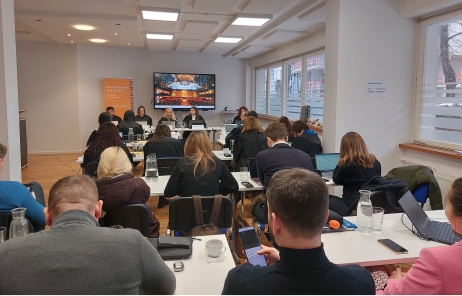
Always a special highlight of the EU Law course: a simulation of a pending case before the Court of Justice of the EU.
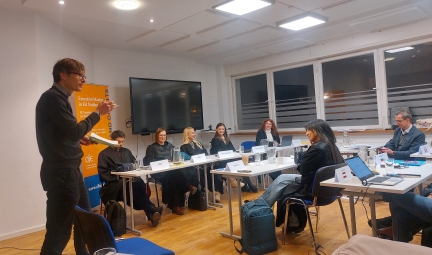
Explaining the specific method and structure of legal argumentation.
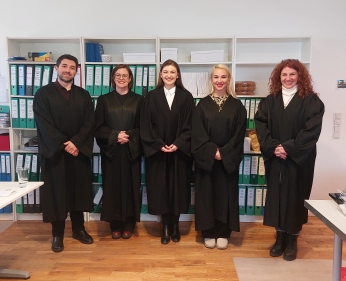
In the simulation, the students of the Executive Master 2024/26 took on the roles of the applicant, Member State agents, judges and the advocate general.