- The EUCACIS Programme Concluded
- Last EUCACIS PhD School took place in Istanbul, Turkey, on 14-15 February 2020
- Successful completion of the regular PhD Support Programme EUCACIS and further extension
- 4th and Final International EUCACIS Conference on “The EU, Central Asia and the South Caucasus: New Approaches on Regional and International Cooperation” took place in Bishkek, Kyrgyzstan
- 4th and final conference taking place in Bishkek, Kyrgyzstan, on 23-24 May 2019
- Retrospection: 3rd EUCACIS conference in Tbilisi, Georgia, 30 - 31 August 2018
- Upcoming EUCACIS Conference in Tbilisi, Georgia
- Open Call for Papers - International Conference "Central Asia and the South Caucasus in Transition: International Perspectives"
- Survey with EUCACIS Fellows
- EUCACIS fellows strengthen their research skills and networks in Berlin
- EUCACIS Wins Second Place in the Competition of Cooperation Projects with Central Asia
- Research Training Stay of EUCACIS Fellows in Berlin
- EUCACIS Conference and PhD School July 2017
- Conference in Berlin on 3-4 July 2017 News
- Call For Applications
- Open Call for Papers
- Interview with Fellow Magda Arsenyan
- Interview with Fellow Tamar Gamkrelidze
- Interview with Fellow Jamshid Normatov
- Interview with Fellow Bahodur Sheraliev
- July 2017 - Second Conference, PhD School and Research Training Stay in Berlin
- 1st EUCACIS international conference took place in Almaty, Kazakhstan
- Launch of the PhD Support Programme EUCACIS for students from Central Asia and the Caucasus
The EUCACIS Programme Concluded

The PhD Support Programme EUCACIS 2016 - 2020 comes to an end in August 2020. The programme has covered three regular years and one extension year, which was an enriching time not only for the EUCACIS fellows, but also for its staff and all involved people.
We are proud of our fellows who worked hard and diligently throughout these years and have completed or reached the final stages of their PhD. By August 2020, six of the twelve EUCACIS fellows have submitted their theses and three of them have already defended and obtained their degrees. The rest are either in the process of finalising their thesis drafts or waiting for final defence after university protocols and publication criteria are fulfilled.
We are delighted to have seen o ur fellows grow from PhD students into junior academics and researchers over these years. The events organized within the EUCACIS programme have also assisted them in forming a strong community of their own but also extending their international academic and professional network. In addition to working on their theses and further developing their skills, the fellows also published extensively whether in local, regional or international academic journals.
Throughout the four years of EUCACIS, we have organized four international conferences, three PhD schools (plus one in the extension period) and one three-week research training stay for each fellow. We were in close touch with the fellows with continuous online coaching, individual mentoring and, not to forget, support and help in view of the challenges that the PhD students faced on their long journey of completing a doctoral thesis. Finally, our fellows and members of the EUCACIS network have contributed to our publishing series, EUCACIS in Brief and EUCACIS Online Paper in which overall 27 articles were published.
We wish our fellows success in their future professional and personal lives. We do not doubt that they will make valuable parts of any field they choose to join, whether in academia or practice. We are convinced that the bonds that the EUCACIS programme has created will sustain and contribute to future cooperation.
Last EUCACIS PhD School took place in Istanbul, Turkey, on 14-15 February 2020
On 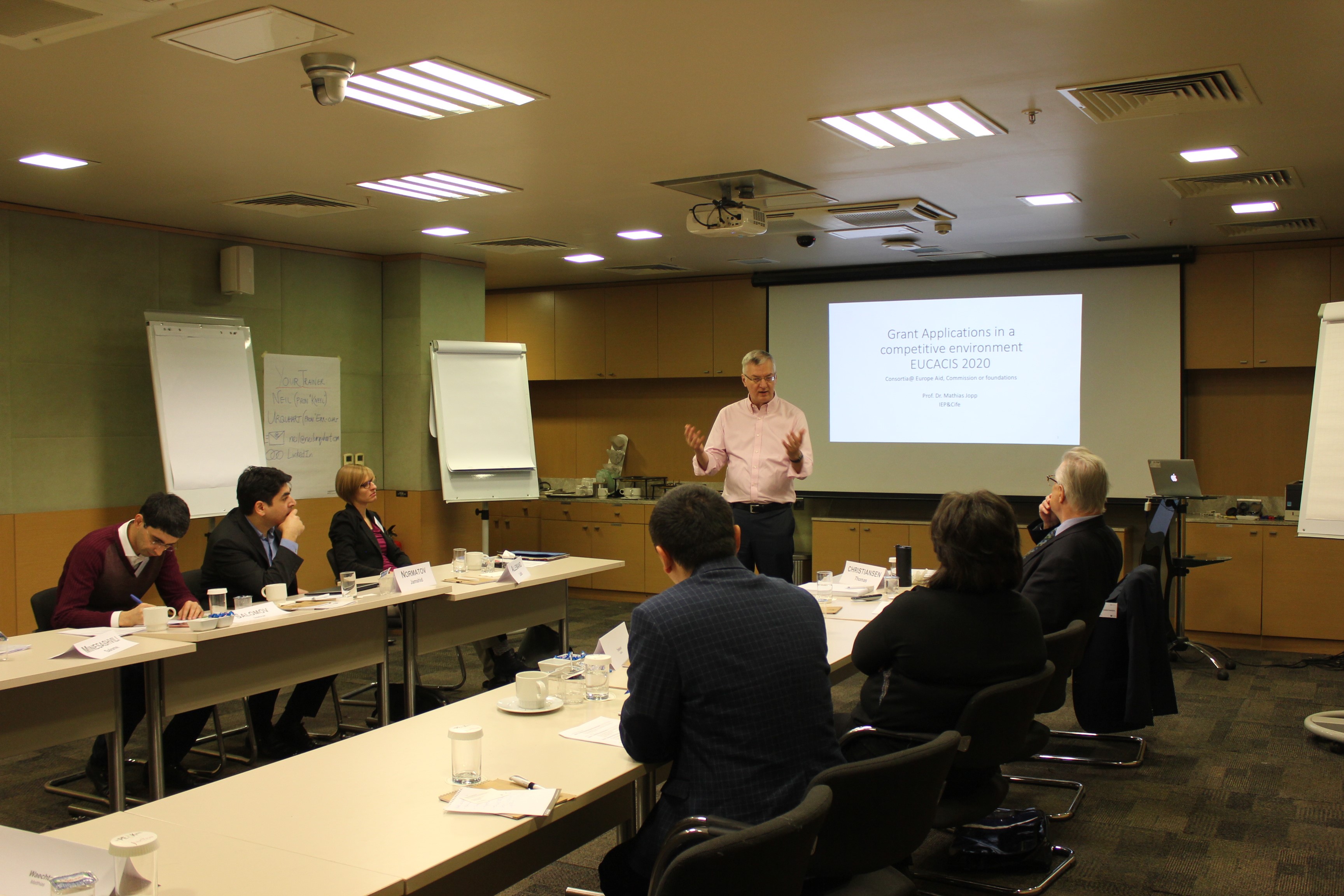 14 and 15 February 2020 the EUCACIS fellows and team came together for the 4th and last EUCACIS PhD School in Istanbul. As their doctorates reach their final stages, the school served the purpose of sharing useful tips and information that could aid them to embark on their career path or disseminate their research after completion.
On the first day, our guest speaker Neil Urquhart trained the fellows on presenting and sharing academic research. The fellows learned techniques for an effective presentation, for engaging and inspiring audiences whether by well-structured content, employing visual stimulus, by voice control or confident body gestures. The training was motivating for the fellows with regard to their teaching activities at university, but also gave them input for the upcoming doctoral defences and for oral presentations of any kind.
On the second PhD School day, Professor Thomas Christiansen from LUISS shared his suggestions with the fellows on academic publishing, 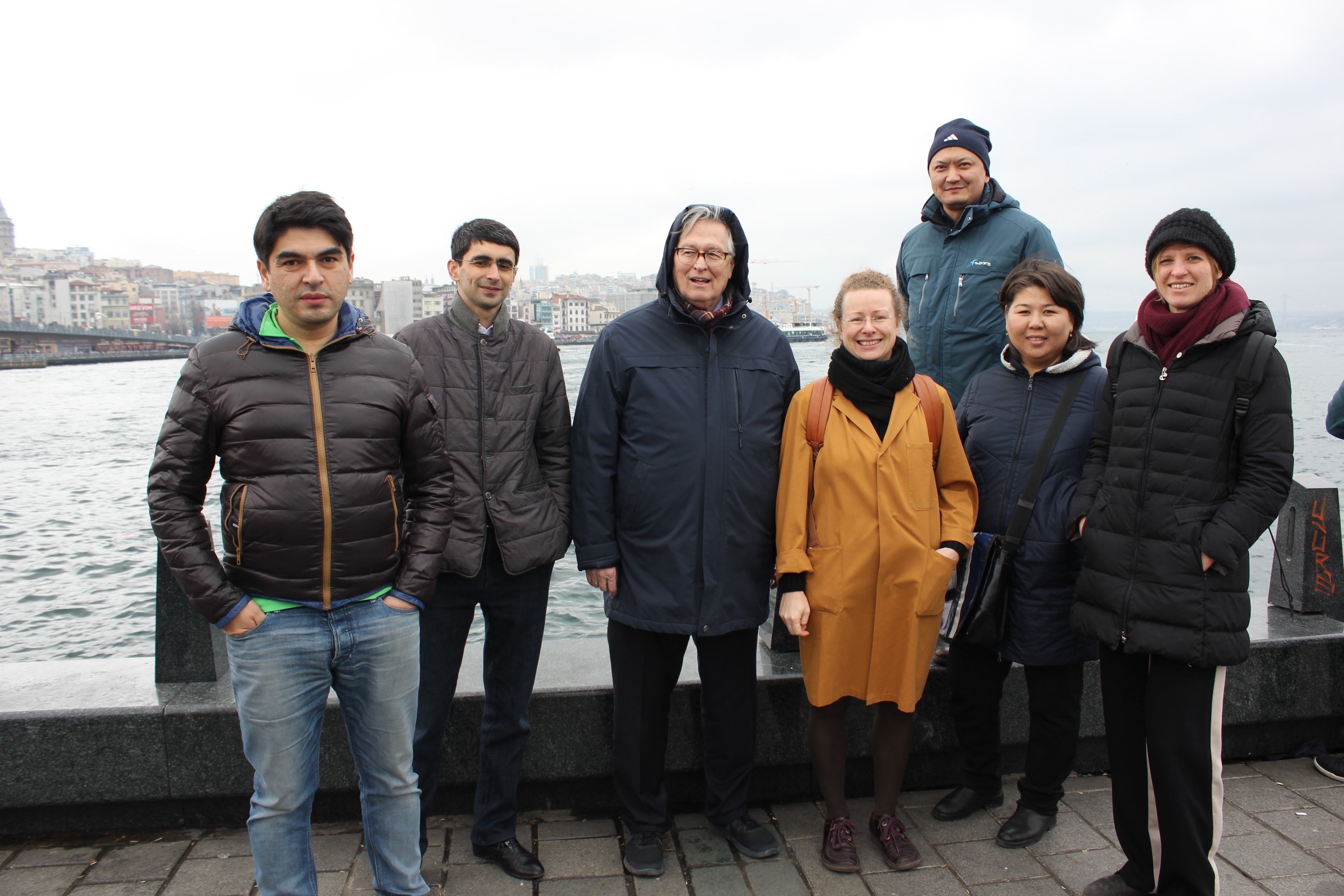 including how to turn the dissertation into a book, how to approach journals or publishing houses, and gave insights of the publication process. Together with EUCACIS programme director Professor Mathias Jopp, he also coached on individual and collective grant proposal writing for academics, motivating the junior researchers to apply for visiting fellowships, post-doctoral projects or international research consortia.
Our fellows also discussed the final stages of their research with their mentors from CIFE and IEP, aiming at overcoming all remaining obstacles in order to submit the final drafts of the theses within the next weeks and months. Finally, fellows and team took the opportunity to discover Istanbul, a metropole at the crossroads of Europe and Asia which is symbolic for the programme that aimed at fostering academic exchange between continents. The 4th PhD School was the last gathering of the EUCACIS PhD Support Programme that will conclude in August 2020.
Successful completion of the regular PhD Support Programme EUCACIS and further extension
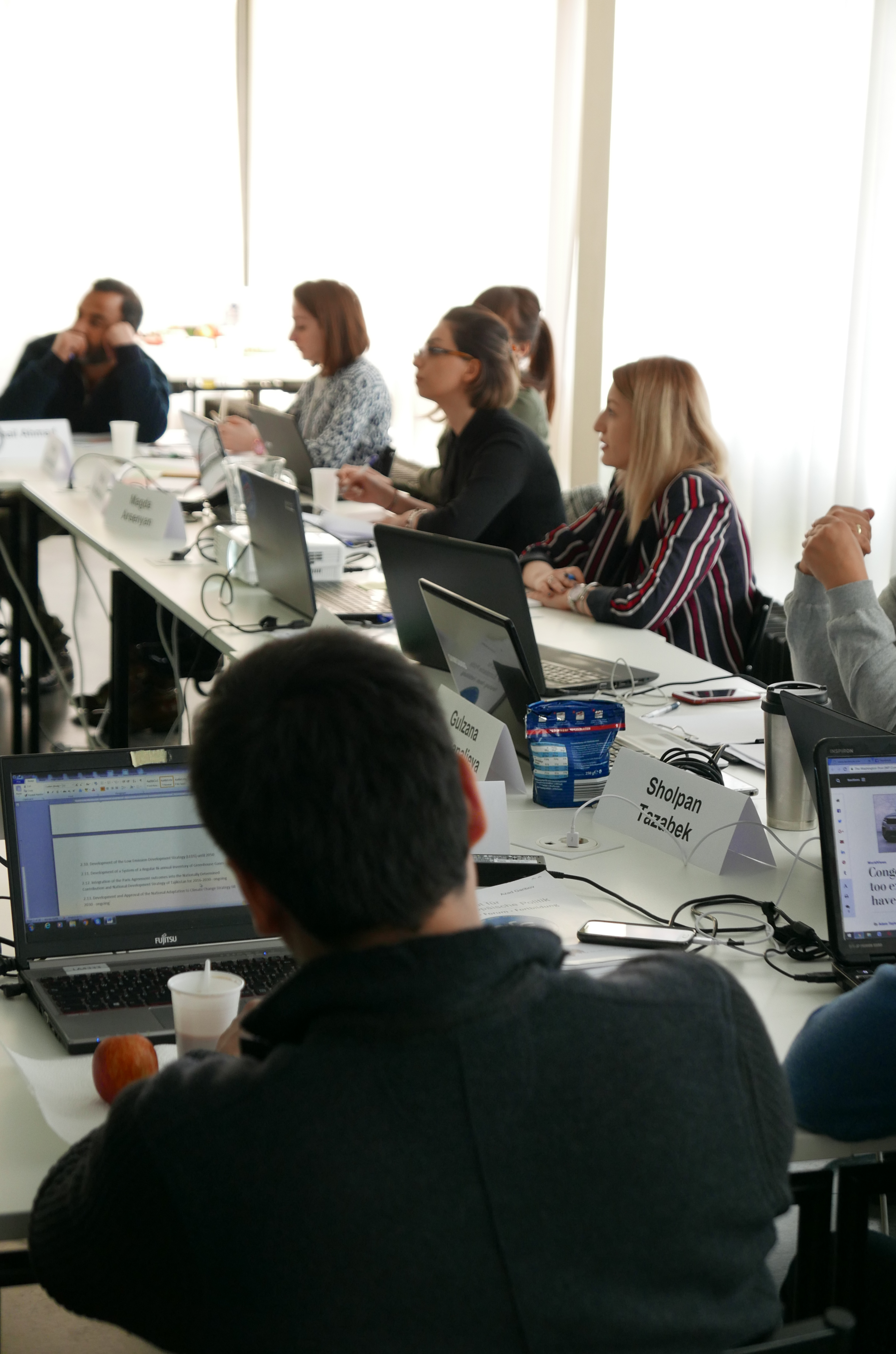 CIFE and the Institut für Europäische Politik (IEP) are happy to announce that the third year of the PhD Support Programme “The EU, Central Asia and the Caucasus in the International System“ (EUCACIS) was successfully completed. Starting in October 2016, the regular programme duration ended in September this year with a good record.
The programme has achieved its main objectives by providing intensive PhD training for its fellows, continuous support in the process of their doctoral work and assisting them in establishing networks in their region and in Europe. In order to achieve these goals, the EUCACIS programme has organized four international conferences in Almaty, Berlin, Tbilisi and Bishkek; it has conducted three PhD schools in Berlin and Tbilisi; and it has offered a research training stay to each of its fellows in Berlin and continuous online coaching. 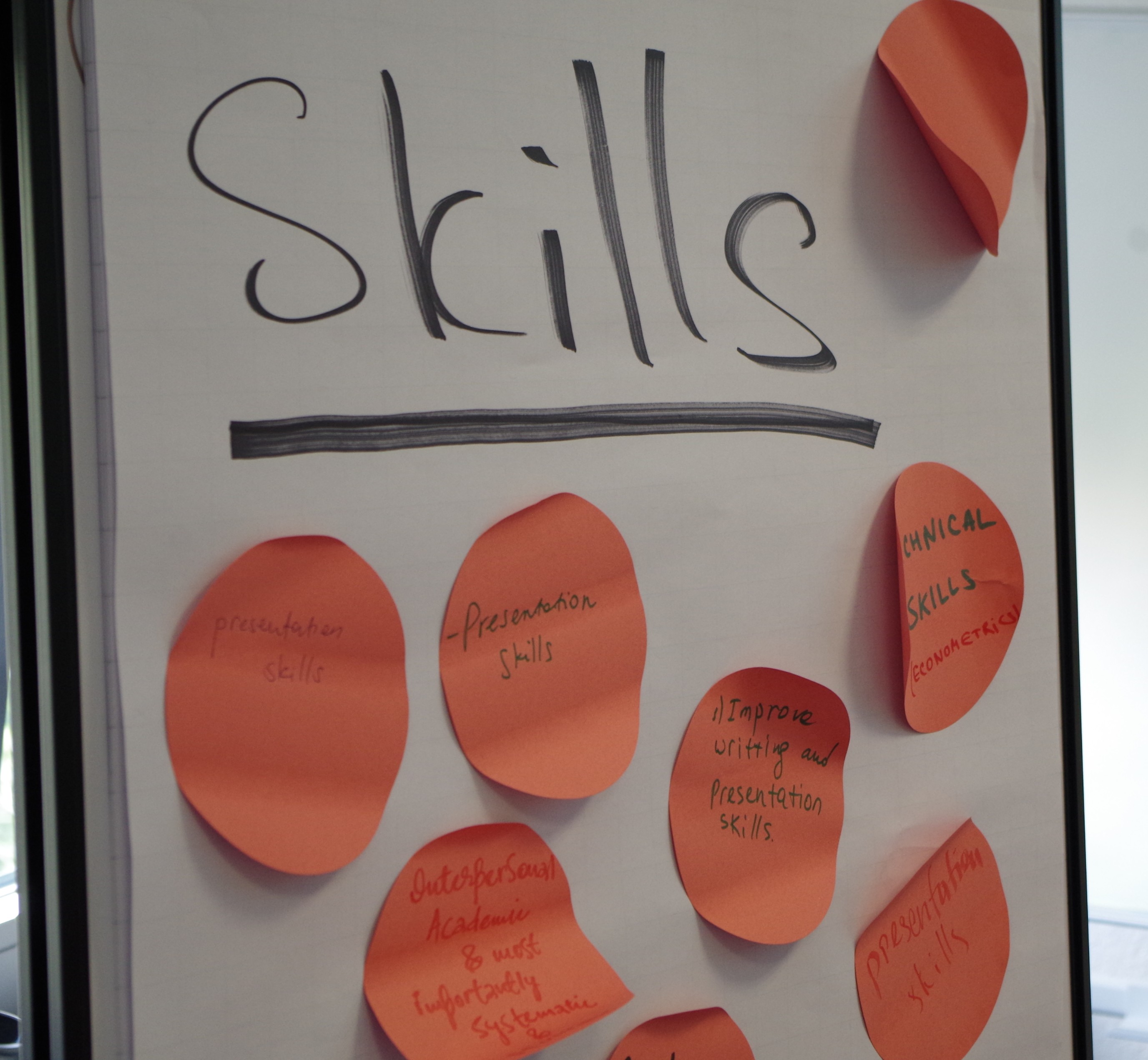 Besides writing their PhD theses, the EUCACIS fellows had to write and publish at least one research or policy paper and actively contribute to the project’s conferences and newsletters throughout the programme.
By the end of the third year, most of the fellows are in the course of submitting their doctoral theses, while four of the EUCACIS fellows have already submitted their PhD theses to their home universities, one of them already having successfully defended it. After defence and graduation, the EUCACIS fellows plan for their next career steps, sometimes achieving a promotion within the institutions where they are already employed, or heading for new academic or professional challenges.
In order to continue support for the fellows that were not able to submit their theses yet, the programme includes an extension period. Accordingly, several fellows were granted extended scholarships for finalizing their academic work. In order to give a last input to the PhD students and accompany the finalisation of their theses, a fourth and final PhD school is planned to take place in February/March 2020. The project will be concluded by August next year, when all twelve fellows will have completed their theses and the further academic work within the framework of the PhD Support Programme.
4th and Final International EUCACIS Conference on “The EU, Central Asia and the South Caucasus: New Approaches on Regional and International Cooperation” took place in Bishkek, Kyrgyzstan
On 23-24 May 2019, the internati.jpg) onal conference “The EU, Central Asia and the South Caucasus: new approaches on regional and international cooperation” took place in Bishkek, Kyrgyzstan. It was the fourth and final conference within the framework of the PhD Support Programme EUCACIS for postgraduates and doctoral researchers from Central Asia and the South Caucasus, which is implemented by the Centre international de formation européenne (CIFE) and the Institut für Europäische Politik (IEP) and funded by the Volkswagen Foundation and Erasmus+. The event was organised with the PhD fellows’ support regarding the conceptualization of the programme as well as in close cooperation with the OSCE Academy in Bishkek.
onal conference “The EU, Central Asia and the South Caucasus: new approaches on regional and international cooperation” took place in Bishkek, Kyrgyzstan. It was the fourth and final conference within the framework of the PhD Support Programme EUCACIS for postgraduates and doctoral researchers from Central Asia and the South Caucasus, which is implemented by the Centre international de formation européenne (CIFE) and the Institut für Europäische Politik (IEP) and funded by the Volkswagen Foundation and Erasmus+. The event was organised with the PhD fellows’ support regarding the conceptualization of the programme as well as in close cooperation with the OSCE Academy in Bishkek.
The conference focused on possibilities of regional and international cooperation in different areas such as border management, migration, trade, energy, and security. Overall, it was agreed that regional cooperation should be enhanced since some challenges can only be tackled together; this especially includes climate as well as security issues. In the latter case, the role of Afghanistan was stressed which should not only be seen as a risk but as a partner..jpg)
On the international level, the role of the EU, Russia, China and the US in Central Asia was discussed. There were views of a declining role of Russia in favour of China and an uncertain future of the US engagement in the region, which currently seems to follow other priorities. Not least, the EU with its offer of a non-exclusive partnership seems to leave a certain room for manoeuvre for the Central Asian states. It was emphasised that a coordinated effort of all external actors involved would be profitable for all sides.
Some EUCACIS fellows acted as competent panel speakers during the conference and enriched the debates with their specific PhD research outputs, while others answered questions relating their dissertation projects in an international expert hearing on “democracy and social change in post-Soviet space”. The young researchers proved once more to be experts in their fields and appeared well prepared to enter the post-doc academic community.
The conference was also the occasion for the official EUCACIS Graduation Ceremony in the impressive setting of a Kyrgyz yurt. The fellows were honoured for their successful participation in the PhD Support Programme and got the chance to look back and recap the past three years together with the EUCACIS team and their supervisors.
The conference successfully allowed international researchers and leading practitioners to meet, exchange, and widen their network. It thus proved to be one of the many valuable opportunities for the PhD fellows during the programme to advance their scientific careers.
You can find the conference agenda here.
.jpg)
International Conference on “The EU, Central Asia and the South Caucasus: new approaches on regional and international cooperation” in Bishkek, Kyrgyzstan, on 23 - 24 May 2019
On 23 - 24th May 2019, the 4th International EUCACIS Conference “The EU, Central Asia and the South Caucasus: new approaches on regional and internationa l cooperation” will take place at ParkHotel in Bishkek, Kyrgyzstan. Experts from the European Union, the South Caucasus and Central Asia will come together to discuss conflicts in the South Caucasus, take a close look at the latest events in Central Asia as well as explore possibilities for cooperation and dialogue between the European Union, the South Caucasus and Central Asia in three different panels.
The conference will be a great opportunity for international researchers and leading practitioners to meet, exchange, and strengthen the bonds between the three regions. The EUCACIS fellows are strongly involved in the conference organisation and will also present their scientific research to the international experts.
The international high-ranking conference is the fourth and last conference of the PhD Programme EUCACIS for Postgraduates and Doctoral Researchers in Central Asia and the South Caucasus, which the IEP and the Centre international de formation européenne (CIFE) organise in close cooperation with the OSCE Academy Bishkek.
The preliminary conference agenda is available here.
The conference takes place within the framework of the PhD Support Programme “The EU, Central Asia and the Caucasus in the International System” (EUCACIS) for Postgraduates and Doctoral Researchers in Central Asia and the Southern Caucasus, organised by the Institut für Europäische Politik (IEP) and CIFE. It is funded by the Volkswagen Stiftung as well as the ERASMUS+ programme. Postgraduates who are working on their doctoral thesis in political sciences contemporary history or economics, on a topic related to its thematic focus at a university or academy of sciences in the Southern Caucasus or Central Asia (including Afghanistan, the Kashmir region in India and the autonomous region Xinjiang in China) get a three-year scholarship and receive skill trainings and PhD schools.
Please register here as soon as possible or at the latest by 20 May 2019.
Retrospection: 3rd EUCACIS conference in Tbilisi, Georgia, 30 - 31 August 2018
On 30 - 31 August 2018 the international conference on „Central Asia and the South Caucasus in Transition: International Perspectives” took place in Tbilisi, Georgia. It was the 3rd conference organised by the EUCACIS PhD Support Programme of the Centre international de formation européenne (CIFE) and the Institut für Europäische Politik (IEP) which is funded by the Volkswagen Foundation and Erasmus+. The event was supported by and took place at the ILIA State University, the city‘s second biggest academic entity. You can find the conference agenda here.
During the 2-day conference, panel debates covered such topics as security and stability, transition processes, as well as the role of the socio-cultural dialogue between Central Asia, the South Caucasus and Europe. In a first panel, the nature of the conflicts in the South Caucasus region has been discussed controversially, and a critical assessment of the role of the EU, Russia, and further external actors in the solution of these conflicts and the development of the region has been made. A second panel debate focussed on opportunities of democratic transformation and interregional cooperation in Central Asia. It has been emphasized that, since Uzbekistan’s opening up under President Mirziyoyev and the launch of the Chinese ‘One Belt One Road’ initiative, regional rapprochement and development has become a priority issue for Central Asia, in particular with regards to tourism, connectivity and trade. Finally, a third panel offered a glance into the challenges of civil society engagement and the role of the ‘European model’ for the political cultures and democratization processes in the Caucasus and Central Asia.
The panel discussions have been continued and deepened in working groups. The debates made clear that, despite the many challenges for peace, stability and prosperity in both regions, great achievements have been made, and the European Union remains an important partner.
During the conference, the twelve EUCACIS fellows were provided with the opportunity to present their research to a wider audience and profit from feedback and panel debates with European, Caucasian and Central Asian academics, decision-makers, and professionals. Following the conference, the fellows participated in the 3rd EUCACIS PhD School.

Upcoming EUCACIS conference in Tbilisi, Georgia
On 30 - 31 August 2018 the 3rd International EUCACIS Conference "Central Asia and the South Caucasus in Transition: International Perspectives" will take place at the Ilia State University in Tbilisi, Georgia.
Experts, decision makers, senior academics and young researchers from more than 16 countries will come together to discuss the latest events and developments in the South Caucasus and in Central Asia, and explore opportunities and dialogue between Central Asia, the South Caucasus, and the European Union. The conference will be a great opportunity for international researchers and practioners to meet, exchange and strenghten the bonds between the three regions.
The EUCACIS fellows are strongly involved in the conference organisation, and will present their research to the international experts.
Following the conference, the 3rd EUCACIS PhD School will be held, where the twelve fellows receive inputs and trainings to further develop their scientific and professional skills.
The conference agenda is available here. Stay informed and follow the discussions #eucacis
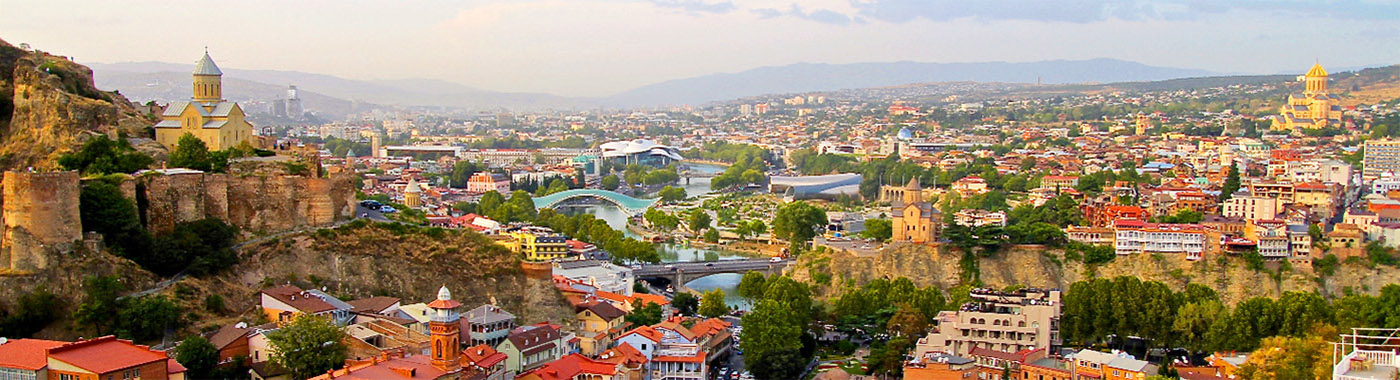
Open Call for Papers - International Conference "Central Asia and the South Caucasus in Transition: International Perspectives"
The Institut für Europäische Politik (IEP) and the Centre international de formation européenne (CIFE) are organising a high-level international conference on the “Central Asia and the South Caucasus in Transition: International Perspectives” at the Ilia State University in Tbilisi on the 30th and 31th of August 2018. The conference is taking place in the framework of the PhD support programme “The EU, Central Asia and the Caucasus in the International System” (EUCACIS) which is organised with significant funding from the Volkswagen Foundation and financially supported by the Erasmus+ Programme.
The Caucasian and Central Asian states are witnessing significant changes in their political landscape at the moment, and are still characterized by their historical background and cultural and religious traditions. With regard to the current developments, the conference is devoted to the discussion of the transition processes Central Asian and the Southern Caucasian countries are undergoing: Which opportunities for democratic transition can be expected in the South Caucasian and Central Asian states? How are internal state building and democracy building processes executed, and what influence do foreign actors have on local politics, civil society and socio-cultural developments? What role does the historical background of the post-soviet countries play in their current political situation? How are the Central Asian and South Caucasian states positioning themselves in the international community, especially in regards to the EU? And which new fields of cooperation between the EU, the South Caucasus and the Central Asian states can be developed and strengthened?
These questions will be discussed with high-level speakers from Central Asia, Europe and the Southern Caucasus as well as researchers and PhD candidates from the three regions. The junior researchers have the chance to present their research projects at the international conference and receive feedback from renowned researchers. The conference offers them networking opportunities with other researchers, university professors and lecturers from Europe and the wider Central Asia. It aims at establishing a European-Central Asia-Southern Caucasus research network, including the fellows of the EUCACIS programme and alumni of the Master Programme “The EU and Central Asia in the International System”.
Submission of paper proposals: IEP and CIFE invite doctoral researchers and MA students in their last year to submit paper proposals, which are related to one of the following topics:
-
The Role of International Organisations in Central Asia and the South Caucasus
-
State Building in the South Caucasus and Central Asia
-
Peace and Stability in the South Caucasus
-
Heritage and Modernity in the Wider Central Asia
-
Political, Social and Cultural Transition in the Wider Central Asia
Please submit your paper abstracts plus a short CV in English to Ms. Janny Schulz by 30st of June 2018. The abstracts should have a length of 300 words. All information can be found here.
Survey with EUCACIS Fellows
What challenges do researchers in Southern Caucasus and Central Asia face during their PhD? How do they deal with them? Who and what helps them to keep their feet on the ground? EUCACIS fellows reflect on their obstacles and how they cope with them in a survey.
“PhD degree will be my key to open a door in academia”, says Tamar Gamkrelidze, a fellow from Georgia. She, like her peers in the EUCACIS programme, sees the PhD as an essential step toward an academic career. The fellows describe the situation for researchers in their countries as challenging but with good prospects. At the same time, they stress that being a PhD candidate faces uncertainty, lack of funding and the support of universities caused by the current state of postgraduate education in the Southern Caucasus and Central Asia.
“Uzbekistan is in the process of adopting and institutionalizing international experience in higher education. Thus, the level of scientific work is changing”, says fellow Jasur Salomov. Indeed, the EUCACIS fellows have noticed many reforms and much progress on the way to a better quality of higher education. More and more universities in the Southern Caucasus and Central Asia are trying to bring doctoral programmes up to international standards, increasing the quality of the collections in their libraries and providing access to databases in foreign universities.
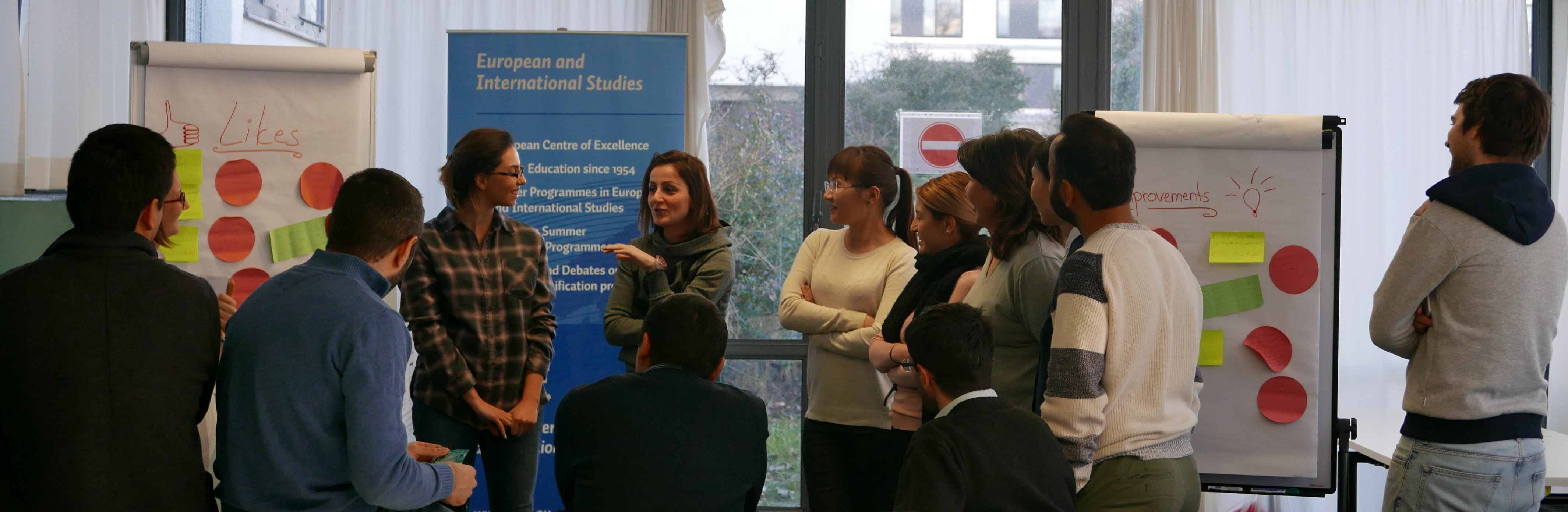
However, postgraduate education in these countries still suffers from many deficiencies. One of the main ones is a poor methodological approach. Almost all the fellows stress the lack of specific classes on methodological tools as well as experienced experts on contemporary research methods. Hence, many fellows feel challenged by conducting a PhD according to international scientific standards. Another big challenge for young scholars is the absence of funding for PhD students. “In order to follow a research career, one has to work and simultaneously study for a PhD. It is challenging for young researchers as they first need to develop their own academic skills”, points out Albina Muratbekova, a fellow from Kazakhstan. In addition, many fellows lack sufficient support from their PhD departments: “They are not interested in the problems or challenges we are facing while doing the PhD. The main support I receive comes from my supervisor.”, says Magda Arsenyan from Armenia.
In fact, almost all the fellows appreciate the great support supervisors in their home countries give them – their feedback and guidance help them to advance their PhD projects.
Participation in the EUCACIS programme also plays a crucial role for the fellows in overcoming the above-mentioned challenges. The special courses, training opportunities and webinars fill the skills gap in methodology. The financial support enables the fellows to stay focused on conducting their PhDs as well as to undertake research trips to relevant regions, archives and libraries. Moreover, interaction with European scientists and networking with peers in the Southern Caucasus and Central Asia, help to ease the EUCACIS fellows’ arduous journey to an academic career.
EUCACIS fellows strengthen their research skills and networks in Berlin
The fellows of the PhD Support Programme “The EU, Central Asia and the Southern Caucasus in the International System” EUCACIS met for the second time to deepen their academic and professional skills. All twelve fellows participated in the PhD School from 19th to 23rd February 2018 in Berlin, where they attended several trainings and lectures, presented their PhD theses and received detailed comments by their EUCACIS team advisors and their peers.
During their PhD School, apart from training on their presentation skills as well as lectures on academic English writing and individual consultations, the fellows learned about strategies for academic publishing. They were presented an editor’s perspective and workflow, and encouraged not to quit working on their articles after receiving critical comments from a reviewer, but to consider them seriously and to revise the article.
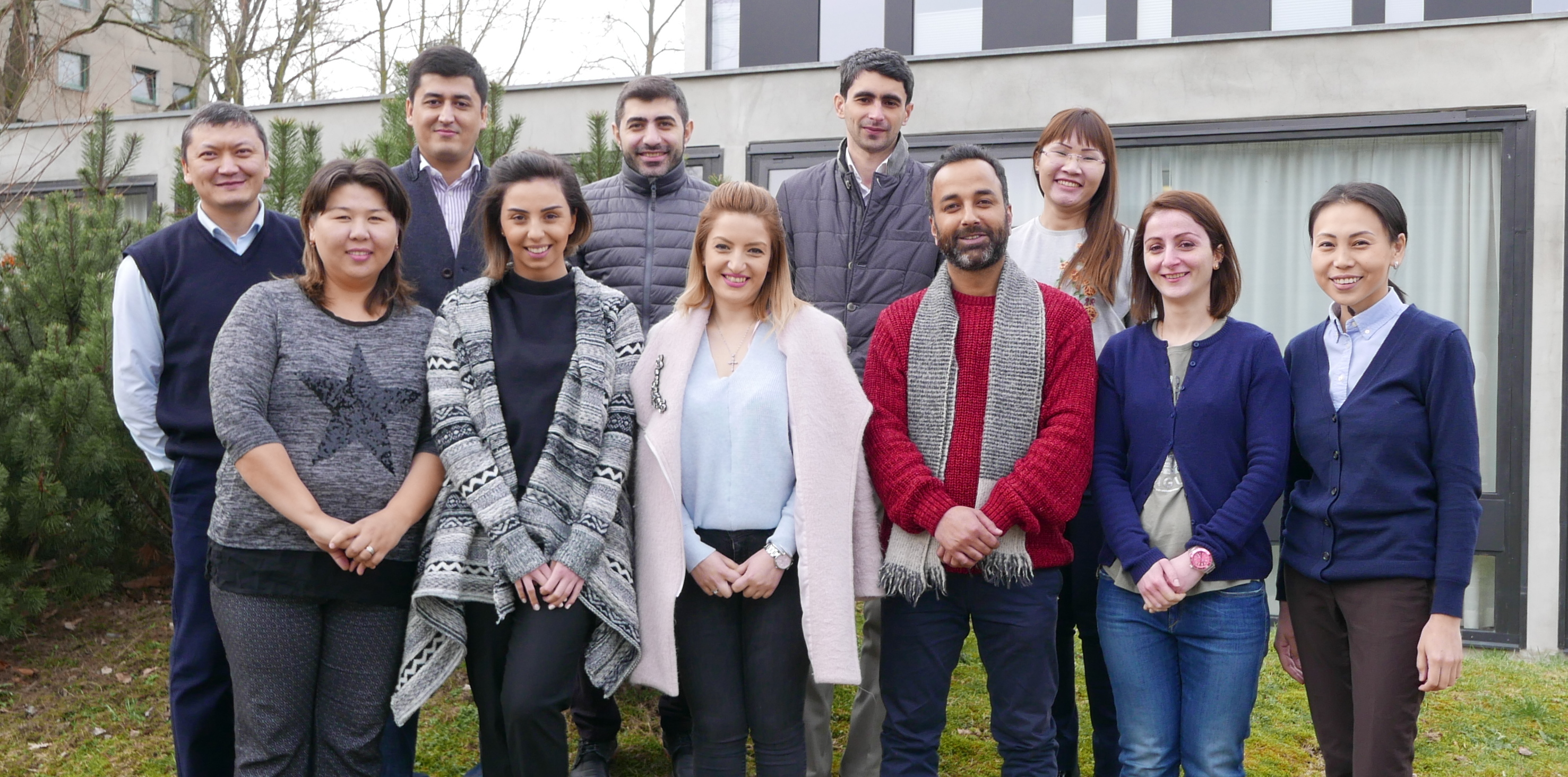
Moreover, the EUCACIS fellows had the opportunity to gain insights into the development of EU-Central Asia relations from a diplomat’s perspective. Michael Siebert, Head of the Division for Central Asia and the Southern Caucasus at the German Federal Foreign Office, presented considerations for the review of the EU-CA Strategy, but was also interested in the opinions of the young scholars regarding the current state of affairs in their home countries and the future cooperation between the EU and Central Asia.
Consecutive to the PhD School, the fellows participated in a Research Training Stay, where they became acquainted with libraries in Berlin and met experts from the Federal Chancellery, the Center for East European and International Studies (ZOiS) and from Human Rights Watch.
The EUCACIS fellows clearly benefitted from those four intensive weeks in Berlin, as they received significant input relevant to their academic careers, and had time to focus on their research in a suitable environment. However, it was not only the fellows who benefitted from the stay. The discussions during Lunch Debates with CIFE and IEP staff on various international relations issues, different academic approaches and cultural features were enriching for all involved in the EUCACIS programme.
EUCACIS Wins Second Place in the Competition of Cooperation Projects with Central Asia
The PhD Support Programme "The EU, Central Asia and the Caucasus in the International System" has won the second place in the competition of cooperation projects with Central Asia. The competition took place in the framework of the “Country Day Central Asia” which was organized by the Federal Ministry of Education and Research (BMBF) on 19 and 20 September 2017. The aim of the contest was to identify innovative and successful projects with Central Asian countries and to present these to an audience of scientists and practitioners in the form of a science slam. Under the motto “Listen, understand and change”, the presentation of EUCACIS focused especially the open dialogue at eye level between young Central Asian and European researchers during the two international EUCACIS conferences. The first price was awarded to an environmental researcher who – together with his Uzbek colleagues – observes the development of the fine dust in Uzbekistan.
Representatives from ministries, foundations, universities and research funding institutions participated in the “Country Day Central Asia”. The focus lay on the internalization strategy of the German federal government in the area of education, science and research, which has been initiated in February 2017 under the auspices of the BMBF. The participants exchanged their experiences and best practices in the cooperation with Central Asian universities and scientists and gave feedback to the BMBF regarding challenges and needs in the field of research funding.
EUCACIS is the only doctoral programme in Germany that financially, professionally and logistically supports doctoral students from Central Asia and the South Caucasus who do their PhD in political science, history, economy and related fields in their home countries. In the course of the programme, the fellows participate in four international conferences, four PhD schools and one research training stay. Between the on-site phases, a blended-learning programme takes place during which the fellows can participate in online courses and interact in online fora. One essential goal of the programme is to create long-lasting networks between the young researchers and, consequently, to foster regional cooperation between states in Central Asian and the South Caucasus.
Research Training Stay of EUCACIS Fellows in Berlin
From 10 until 28 July 2017, the first research training stay with 6 fellows from the PhD Support Programme “The EU, Central Asia and the Southern Caucasus in the International System” (EUCACIS) took place in Berlin. The programme participants have either full-time or part-time jobs next to their PhD projects, so the attendance phase in Berlin provided them with the opportunity to concentrate on their PhD research, visit Berlin libraries and relevant institutions and conduct interviews.
Especially the main library of the Humboldt University – the Jacob-und-Wilhelm-Grimm-Zentrum – was a popular place for the fellows to visit. Its large selection of literature on the economic, political and social development in Central Asia and the South Caucasus was greatly beneficial for the fellows who often complain about difficulties with access to relevant literature at the universities in their home countries.
In the course of the three weeks, the fellows visited several political institutions and think tanks such as the German Institute for International and Security Affairs (SWP), the German Council on Foreign Relations (DGAP), the Bundestag etc. The highlight was usually the exchange with the expert of the respective institution and the possibility to ask questions related to the fellows’ field of research. At the Ministry of Foreign Relations (AA), for instance, a fruitful debate on the Nagorno-Karabakh took place with the Head of the Political Department, Michael Siebert.
The EUCACIS fellows conduct their research in the field of international relations, political science, history, economy and related fields. They come from eight countries in Central Asia and the Southern Caucasus and have been selected from a large group of applicants in a competitive process. During the 3-years programme, the fellows will participate in four conferences, four PhD schools and one research training stay. Furthermore, they will receive online training and individual consultation from the EUCACIS team throughout the programme. EUCACIS is organized by Centre international de formation européenne (CIFE) and the Institute for European Politics (IEP) and is funded by the Volkswagen Foundation and Erasmus+.
EUCACIS Conference and PhD School July 2017
In the course of the PhD Support Programme EUCACIS, an international conference and PhD School took place from 3rd to 8th July 2017. The goal of both events was to provide the selected PhD fellows from Central Asia and the South Caucasus with the opportunity to present their PhD projects, deepen their understanding of current challenges and developments in the respective regions and to widen their networks. The EUCACIS programme is organized by CIFE and the Institute for European Politics (IEP) and funded by the Volkswagen Foundation and Erasmus+.
During the 2-day-long conference, the focus was on geopolitical change in Central Asia and the Southern Caucasus and the future role of Europe in that region. H.E. Ambassador Peter Burian, EU Special Representative for Central Asia, offered an intriguing glance into the EU’s strategy for Central Asia, which he assessed as a „magnitude of challenge“. In particular, he emphasized the EU’s effort to support Central Asian states in enhancing administrative capacity and building up domestic economies which currently suffer from low oil prices, shrinking remittances and a lack of reforms. Moreover, the EUCACIS fellows were able to witness panel debates between scientists and practitioners from the respective regions and discuss their PhD posters with the conference visitors during lunch breaks.
During the four days of the PhD School, the EUCACIS fellows received thematic and methodological input from selected experts and had the chance to present their PhD projects to EUCACIS staff as well as to get individual feedback. In addition to lectures on „International Relations Theory“, „Democracy Theory“ and „Comparative Regionalism“, the focus was on the design and publication of a policy paper which the fellows have to write in the course of the EUCACIS programme. For half of the fellows, the PhD School is followed by a 3-week research training stay during which they can make use of CIFE / IEP facilities and resources to conduct their research. The experience of spending 4 weeks in Berlin and closely interacting with researchers from different countries will certainly not only enhance the academic competences of the EUCACIS fellows, but also contribute to a better intercultural understanding.
Conference in Berlin on 3-4 July News
Conference on “Geopolitical Change in Central Asia and the Southern Caucasus” in Berlin on 3/4 July
The international conference “Geopolitical Change in Central Asia and the Southern Caucasus: Which Future Role for Europe?” organized by CIFE and the Institut für Europäische Politik (IEP) will take place on 3-4 July 2017 at the premises of the Representation of the European Commission to Germany (Unter den Linden 78, 10117 Berlin, Germany).
We are especially pleased to welcome the EU Special Representative for Central Asia H.E. Ambassador Peter Burian as a keynote-speaker on the second day of the conference. He will speak on the “Prospects of EU-Central Asia Relations”.
The conference is taking place within the framework of the PhD Support Programme “The EU, Central Asia and the Caucasus in the International System” (EUCACIS). It will involve well-known experts and high-ranking decision-makers as well as young researchers who will discuss the role of global and regional powers in Central Asia and the Southern Caucasus as well as the consequences for EU’s future policies towards both regions. It will spur discussions about a new start for the relations between Russia and the US, its implications for Central Asia and the South Caucasus and the role of the “late global power” China.
EUCACIS fellows will be able to present their posters during the conference and get in touch with the involved scientists and conference participants.
The conference agenda is available here.
Please register here as soon as possible or at the latest by 28 June 2017.
Call for Applications
CfA: Fellowship for a Doctoral Student from Central Asia and the Southern Caucasus
We are happy to announce that we are able to offer one additional fellowship in the framework of the PhD Support Programme “The EU, Central Asia and the Caucasus in the International System” (EUCACIS). The deadline for application is 31 August 2017.
Funded by the Volkswagen Foundation and the Erasmus+ programme, the EUCACIS PhD Support Programme offers scholarships of 300 Euro per month for three years and a travel grant of up to 500 Euro for field research to excellent postgraduates who are working on a doctoral thesis in political science, contemporary history or economics on a topic related to the programme’s thematic focus at a university or academy of sciences in the Southern Caucasus or the wider Central Asia (including Afghanistan, the Kashmir region in India, and the autonomous region Xinjiang in China).
In addition, the programme provides intensive PhD research training to coach its participants in international academic standards and help them to establish their own networks with other young researchers. It offers (travel costs and accommodation are covered by the programme):
- four international conferences in Almaty, Berlin, Yerevan, and Bishkek;
- three PhD schools in Berlin, Yerevan, and Istanbul;
- one research training stay of three weeks for individual training, supervision and research in Berlin;
- mentoring by postdoctoral researchers for three years;
- continuous online coaching including courses on methodology in political science, economics and contemporary history.
The deadline for application is 31 August 2017.
For information on the eligibility and the details of the application process see the attached flyer.
Please find here the application form which needs to be submitted along with all other documents.
For further information about the EUCACIS programme please refer to our brochure.
If you have any questions, please do not hesitate to contact the EUCACIS team.
Email: info@eucacis.eu
Open Call for Papers
The Institut für Europäische Politik (IEP) and the Centre international de formation européenne (CIFE) are organising a high-level international conference on the “Geopolitical Change in Central Asia and the Southern Caucasus: What Future Role for Europe?” in Berlin on the 3rd and 4th of July 2017. The conference is taking place in the framework of the PhD support programme “The EU, Central Asia and the Caucasus in the International System” (EUCACIS) which is organised with significant funding from the Volkswagen Foundation and financially supported by the Erasmus+ Programme.
The geopolitical framework of the EU’s relations with Central Asia and the Southern Caucasus has changed significantly. China shows increasing interest in cooperating with the Central Asian countries while Russia pursues its ambitions in its immediate neighbourhood through the Eurasian Economic Union. The interest of the US in both regions has decreased since Clinton’s Silk Road Initiative. Whether the Trump administration will change this, remains unclear. Also regional powers, such as India, Iran and Turkey have put stronger emphasis on their policies towards the regions. Against this backdrop, the EU has to discuss the renewal of its strategy for Central Asia (the current dates back from 2007) and the adjustment the European Neighbourhood Policy with regard to the Southern Caucasus. The debates have to consider the changing geopolitical context as well as domestic factors in the target countries and in the EU, notably the process of implementing the new EU “Global Strategy”.
With regard to these current developments, the conference is devoted to the discussion of the prospects of the EU’s role in Central Asia and the Southern Caucasus: Which lessons can be drawn from previous cooperation with the target countries? How should the EU position itself towards China, Russia, the US and regional powers in Central Asia and the Southern Caucasus? How can the EU implement the “Global Strategy” in its policies towards the regions? Which new challenges will the regions face in the next years? How can the states in both regions and global actors cooperate to deal with these challenges? Is there an option for regional integration or cooperation to address these challenges?
These questions will be discussed with high-level speakers from China, Central Asia, Europe, Russia, the Southern Caucasus and the US as well as researchers and PhD candidates. The junior researchers have the chance to present their research projects in the international conference and receive feedback from renowned researchers. The conference offers them networking opportunities with other researchers, university professors and lecturers from Europe and the wider Central Asia. It aims at establishing a European-Central Asia-Southern Caucasus research network, including the fellows of the EUCACIS programme and alumni of the Master Programme “The EU and Central Asia in the International System”.
Submission of paper proposals:
IEP and CIFE invite researchers to submit paper proposals, which are related to one of the following topics:
- EU-Central Asia relations;
- EU-Southern Caucasus relations;
- The role of China, Russia, and the US in both regions;
- The role of regional actors in both regions;
- Regional integration in Central Asia and in the Southern Caucasus;
- Assessment of the EU’s policy towards Central Asia and towards the Southern Caucasus;
- The review of the European Neighbourhood Policy;
- The review of the EU Central Asia Strategy;
- Implementation of the EU Global Strategy in policies towards both regions;
- Security challenges in both regions;
- Transition in states of both regions;
- Democracy promotion in both regions;
- Economic developments and trade relations with both regions;
Please submit your paper proposal in English to Mr. Julian Plottka, (julian.plottka@iep-berlin.de) by 31st of May 2017. Paper proposals should have a length of 300 words and include full contact details.
Invitation to the Conference:
Participants of the working groups of the international conference will be selected from the submitted paper proposals by a board of reviewers. Selected participants do not have to pay a conference fee; food and drinks will be provided.
About the Institut für Europäische Politik (IEP):
Since its founding (1959), the IEP has been a non-profit organisation dedicated to the study of European integration and of the EU in the international system. It is one of the leading foreign and European policy research centres in the Federal Republic of Germany and serves as a forum for exchange between academia, politics, administration and political education.
More information: www.iep-berlin.de
About the Centre international de formation européenne (CIFE)
Established in 1954, CIFE is a private, non-profit international organisation, receiving the support of the European Union and other organisations. CIFE has offices in Nice, Berlin, Brussels and Istanbul. The programmes of CIFE encompass educational and research activities concerning European integration, federalism, regionalism and changes within the structure of contemporary society in accordance with a federalist perspective.
More information: www.cife.eu
Contact Details:
If you have any further questions, please do not hesitate to contact Mr. Julian Plottka (julian.plottka@iep-berlin.de).
Interview with Fellow Magda Arsenyan

Name: Magda Arsenyan
Country: Armenia
Degree: MA in Public Administration
Academic discipline: Political Science
Specialisation: Political Processes and Institutions
Topic of the doctoral thesis: Preconditions for the Establishment of Parliamentary Culture in Armenia
How would you explain the topic of your dissertation to a non-expert in the field? Talking to a non-expert, I would bring up a synonym of “parliamentary culture” – namely the “nationwide dialogue” between state and society. We all have our own role in the establishment and further development of that constructive dialogue. Parliamentary culture reflects not only the behaviour of political actors, but also the mentality of civil society. It illustrates the ability of state and society to listen to each other and the political will to achieve a compromise.
I am writing a doctoral thesis because my topic is directly linked to the political processes that are taking place in Armenia at the moment. As a result of the referendum on constitutional reforms in 2015, the Republic of Armenia is moving from a semi-presidential to a parliamentary system of government. This new stage in the history of Armenia brings different challenges. The scientific innovation of the topic lies in researching an unprecedented transformation process: the establishment of a parliamentary culture. Society has to perceive the parliament not only as a legislative body, but as a supreme state, legal and political institute. The parliamentary culture reflects the political consciousness of the state. The formation of the parliamentary culture should be an opportunity to balance public supply and demand as well as the legal and social policy conducted by the state. In consequence, a dialogue between state and society has to be established based not on continuing internal political conflicts, but rather on mutual trust, understanding and compromise.
What are your expectations from the EUCACIS programme? I expect to gain a lot of knowledge and to get the opportunity to cooperate with highly qualified professors, with whose support I will become an expert in my field of specialisation.
In ten years, I see myself as an official representative of the Ministry of Foreign Affairs of the Republic of Armenia.
If I was not doing a PhD right now, I would choose the business sector and establish a company which would organise different kinds of events in Armenia and abroad. That would offer an opportunity to be part of different cultures, bring new acquaintances and also a new mentality. One would get the chance to create a cultural movement in everyday life.
Interview with Fellow Tamar Gamkrelidze
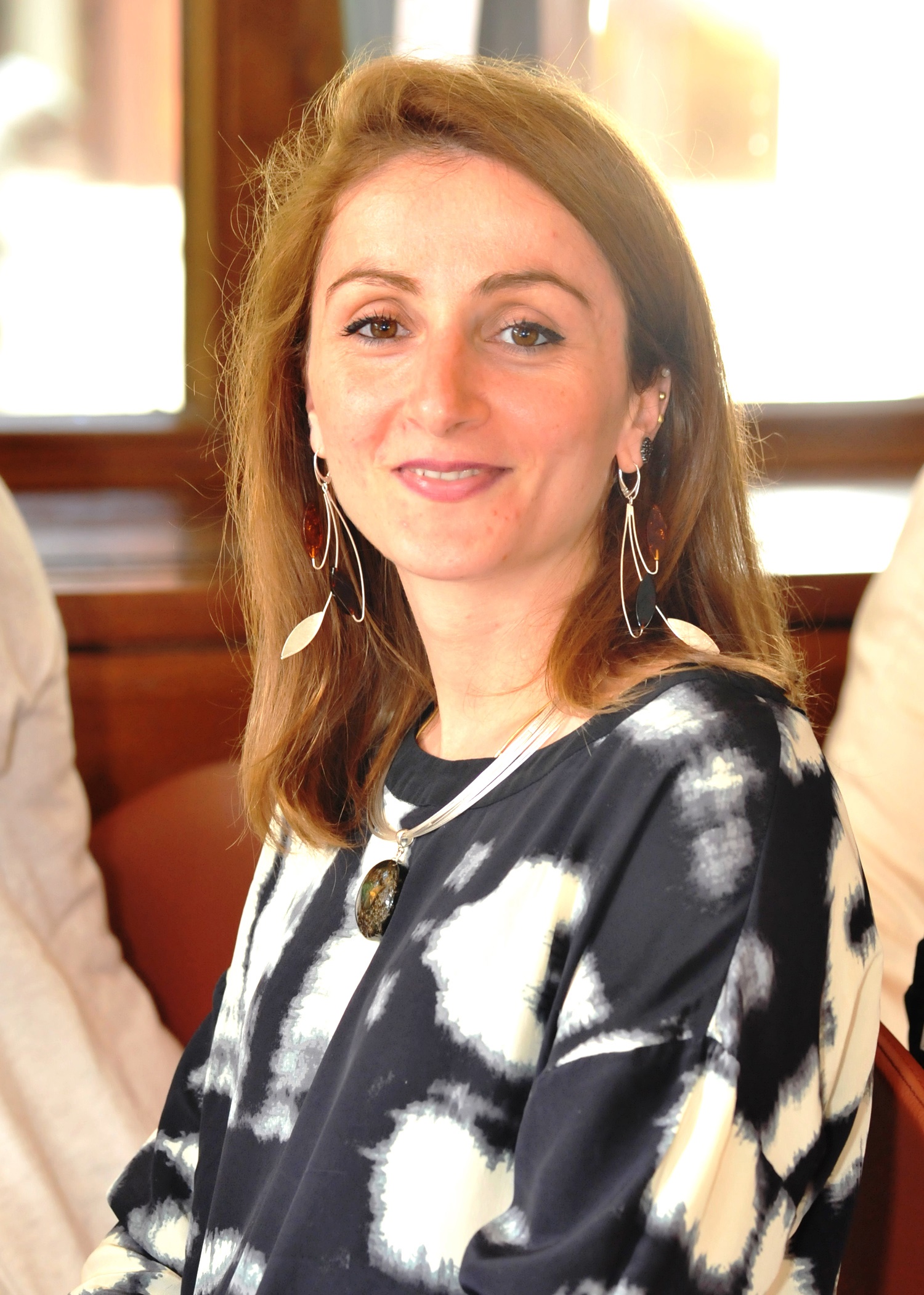
Name: Tamar Gamkrelidze
Country: Georgia
Degree: MA in European Studies
Academic discipline: Political Science
Specialisation: European identity and discourse theory
Topic of the doctoral thesis: The Role of Europe in the Identity Formation of Post-Soviet Georgia
How would you explain the topic of your dissertation to a non-expert in the field? The topic of my dissertation relates to identity formation of the Georgian people from 2004–2013. The thesis scrutinises the political elites’ activities to redress national identity through introducing the European project in post-Soviet Georgia. The main focus of my research is the discourse of the political elites which they used in order to persuade the Georgian people of the Europeanness of their country. The interest of the study is to see to what extent the political elites managed to Europeanise the national identity of Georgia within the given timeframe. With this aim, the doctoral project looks into public political narratives in order to explore how the political elites defined the concept of Europe and also how they connected Europe with the basic concepts of nation and state. The data generated through a discourse analysis will produce a picture of the political identity of Georgia.
I am writing a doctoral thesis because the topic I am working on inspires me every single day.
What are your expectations from the EUCACIS programme? I expect the EUCACIS programme to introduce me to intellectuals willing to network, discuss and provide feedback on my research. This is because exchange of opinions and especially input from a colleague are an eye-opener, as it is through this process that unforeseen and new aspects of a topic emerge, thus keeping the research on the right track. Training and mentoring are another feature of the programme which promises to boost my knowledge as well as skills. The programme also assists fellows to become more disciplined and dedicated to the writing process. Last but not least, participation in the conferences, which offer the opportunity to mingle and talk with high profile political scientist in Europe, is a lifelong, invaluable experience.
In ten years, I see myself in academia, teaching and researching on European identity and the EU external affairs, in particular focusing on Eastern Partnership countries. In parallel to my career, I truly hope to start a family and have kids.
If I was not doing a PhD right now, I would hold an administrative position either at an international organization or a governmental institution.
Interview with Fellow Jamshid Normatov

Name: Jamshid Normatov
Country: Uzbekistan
Degree: MA in European Studies
Academic discipline: World Economy
Specialisation: International Economics
Topic of the doctoral thesis: Financial liberalization under WTO: opportunities and risk for developing economies
How would you explain the topic of your dissertation to a non-expert in the field? My topic concerns the issue of financial liberalization in developing countries. The World Trade Organization promotes trade in goods and services worldwide. Financial services trade is important for developing countries because it has potential for providing access to funding for people and businesses. This can reduce the costs of borrowing and promote investments. These, in turn, can generate new jobs, higher incomes for people and more tax revenues for the government. However, financial liberalization contains risks. It may lead to dependency of developing countries on foreign borrowing and may result in financial crises if foreign banks decide to stop lending. My research aims to provide a rationale for financial liberalization and to recommend regulation models for developing countries to minimize liberalization risks.
I am writing a doctoral thesis because I pursue the goal of becoming an educational leader and academic authority in international economics.
What are your expectations from the EUCACIS programme? I expect the EUCACIS programme to provide me with academic advice on my doctoral research as well as networking opportunities with leading specialists in my field of research. I am also hopeful that the programme will help me with getting access to information related to my research as well as assist me with publishing my research findings in peer-reviewed journals in the EU.
In ten years, I see myself as a policy advisor on economic policy-making working with the Uzbek government, international organizations, and business. I believe by then I will have gained experience and be prepared to become a public leader in my country, who will enact policies in support of development and growth.
If I was not doing a PhD right now, I would have less chances of being promoted in my current job. I need the PhD to assume more responsible – senior management – positions within the university.
Interview with Fellow Bahodur Sheraliev
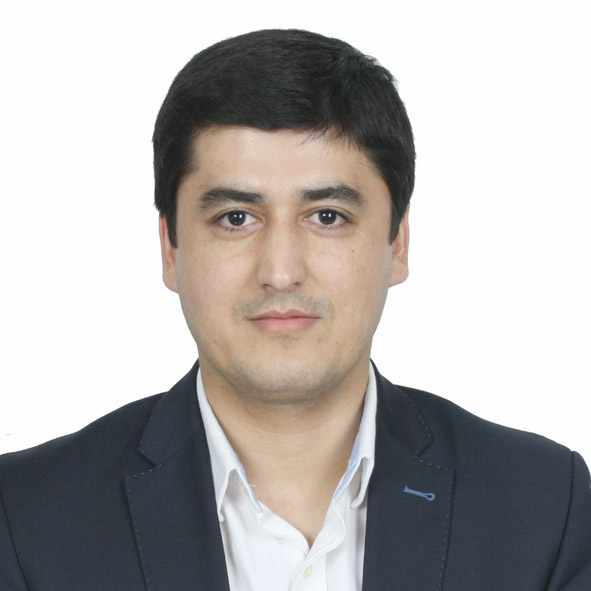
Name: Bahodur Sheraliev
Country: Tajikistan
Degree: MA in Global Political Economy
Academic discipline: International Relations, Political Economy
Specialisation: Climate Change Mainstreaming, Policy Advice
Topic of the doctoral thesis: Tajikistan in United Nations Framework Convention on Climate Change Multilateral Negotiations Process: Achievements, Commitments and Perspectives for Tajikistan
How would you explain the topic of your dissertation to a non-expert in the field? Tajikistan is a mountainous landlocked country that is severely affected by the negative consequences of climate change: the melting of glaciers, the Aral Sea shrinking, floods and droughts impact over 70 percent of its population. Tajikistan has been active in multilateral climate change negotiations, but without being able to take a strong position. Tajikistan has signed the UNFCCC (United Nations Framework Convention on Climate Change) Paris Agreement and submitted a nationally determined contribution to reduce its greenhouse gas emissions. In order to fulfill its international commitments, Tajikistan has to go through a complex five-year long process. Unfortunately, many experts from the key ministries lack knowledge on climate change in general as well as on the substance and commitments agreed upon by the country in the Paris Agreement in particular. Thus, a comprehensive analysis of Tajikistan’s commitments and the implementation roadmap is of utmost importance for domestic administrations and decision-makers.
I am writing a doctoral thesis because I would like to project how international framework agreements, namely the UNFCCC Paris Agreement, can shape domestic policy development in the field of climate change.
What are your expectations from the EUCACIS programme? I expect to gain sound knowledge in research methods through mentoring by postdoctoral researchers and online coaching; to use the opportunity for joint publications; to communicate with young researchers and expand my network within the academic community in the EU, Central Asia and the Caucasus. I would like to gain as much as possible from tutors, conferences, online courses, and training sessions.
In ten years, I see myself holding a decision-making position within government, dealing with climate change issues in Tajikistan and leading a negotiation platform in UNFCCC. I see myself as high-level government expert working in the field of climate change policy in Tajikistan. I am a leading professor at a university teaching International Relations with a particular focus on climate change in Central Asia, writing and publishing in international academic journals, giving lectures at leading universities of the region and providing mentorship for young scholars. I am a professional marathon runner and see myself as the champion of Tajikistan in the nine-kilometer or semi-marathon competition and as a participant in international and regional marathon competitions.
If I was not doing a PhD right now, I would continue working as an advisor for the Committee on Environmental Protection of Tajikistan for climate change mainstreaming and climate finance access. I would continue teaching at the university, but as an assistant to professors rather than myself designing and holding courses for students.
July 2017- Second Conference, PhD School and Research Training Stay in Berlin
While the EUCACIS fellows are working on the online courses and receive coaching via the elearning platform, the team already prepares the next events: a second conference, a first PhD school and a first research training stay in Berlin in July 2017.
The two-day conference will bring together the EUCACIS fellows with renowned experts to discuss the role of global and regional powers in both Central Asia and the Southern Caucasus and the one-week PhD school will coach the fellows in academic skills, higher education qualifications and networking. It will also include a young researchers session that will provide doctoral research from Central Asia, Europe and Southern Caucasus with the opportunity to present and discuss their latest research. For the first time in the framework of the programme, the EUCACIS fellows will present their PhD projects to a wider public and receive feedback from their colleagues, mentors and experienced academics. Last but not least, around six of the EUCACIS fellows will extend their Berlin stay for another three weeks to participate in the research training stay, combining academic training, visits to research institutions, and individual research.
Launch of the PhD Support Programme EUCACIS for students from Central Asia and the Caucasus
CIFE and the Institut für Europäische Politik (IEP) start the PhD Support Programme “The EU, Central Asia and the Caucasus in the International System“ (EUCACIS). Funded by the Volkswagen Foundation and the Erasmus+ Programme, it offers scholarships for three years to excellent postgraduates who are working on a doctoral thesis in political science, contemporary history or economics on a topic of the programme’s focus at a university in the Southern Caucasus or Central Asia (including Afghanistan, the Kashmir region in India, and the autonomous region Xinjiang in China).
It is the objective of the EUCACIS programme to provide intensive PhD research training for its participants to bring them closer to international standards, to support them until they submit their doctoral theses, and to help them establish their own networks with other young researchers in the target regions and in Europe. This will be achieved through four international conferences (in Almaty, Berlin, Yerevan, and Bishkek); three PhD schools in Berlin, Yerevan and Istanbul; two research training stays; and continuous online coaching.
The programme is open for postgraduates who have started to work on a PhD or an equivalent degree at a Central Asian or South Caucasian university in the fields.
1st EUCACIS international conference took place in Almaty, Kazakhstan
On 30 and 31 August 2016, the international conference “The EU, Central Asia and the Caucasus in the International System” (EUCACIS) took place in Almaty (Kazakhstan). The conference served as the kick-off event for the identically named PhD Support Programme which is jointly organised by the Centre international de formation européenne (CIFE) and the IEP and funded by the Volkswagen Foundation and the Erasmus+ Programme of the European Union. The event also profited from financial support of the Friedrich-Ebert-Stiftung.
The conference has been attended by experts and contributors from Central Asia, the Southern Caucasus, Europe, China, India and Russia who discussed various aspects of the relations between the EU, Central Asia and the Caucasus as well as current developments and challenges in policy fields such as water, resources and trade, security and foreign policy.
In his keynote speech, Dr. Michael Emerson Senior Research Fellow at the Centre for European Policy Studies (CEPS), illustrated areas of intra- and inter-regional cooperation and regionalization in fields such as transport or trade, but also a number of cleavages between the regions and single countries that emerge. Prof. Dr Mirzokhid Rakhimov, Head of the Contemporary History and International Relations Department of the Institute of History at the Academy of Sciences of Uzbekistan, asked in his keynote speech about “The New Great Power Contest for Central Asia?”. In subsequent panel discussions, experts examined foreign policy options of the Central Asian and South Caucasian states and attempts of regionalisation in both regions.
During a final selection process on the brink of the conference, the fellows of the PhD Support Programme were selected among the applicants from Afghanistan, Armenia, Azerbaijan, Georgia, Kazakhstan, Kyrgyzstan, Tajikistan, Turkmenistan, Uzbekistan as well as from the Chinese region of Xinjiang and the Indian region of Kashmir. For the upcoming three years, the EUCACIS fellows will receive scholarships and academic support while writing their doctoral thesis.
You can find the conference agenda here.
